Home › Blog › How to choose a large landscape print
How to choose a large landscape print for your wall
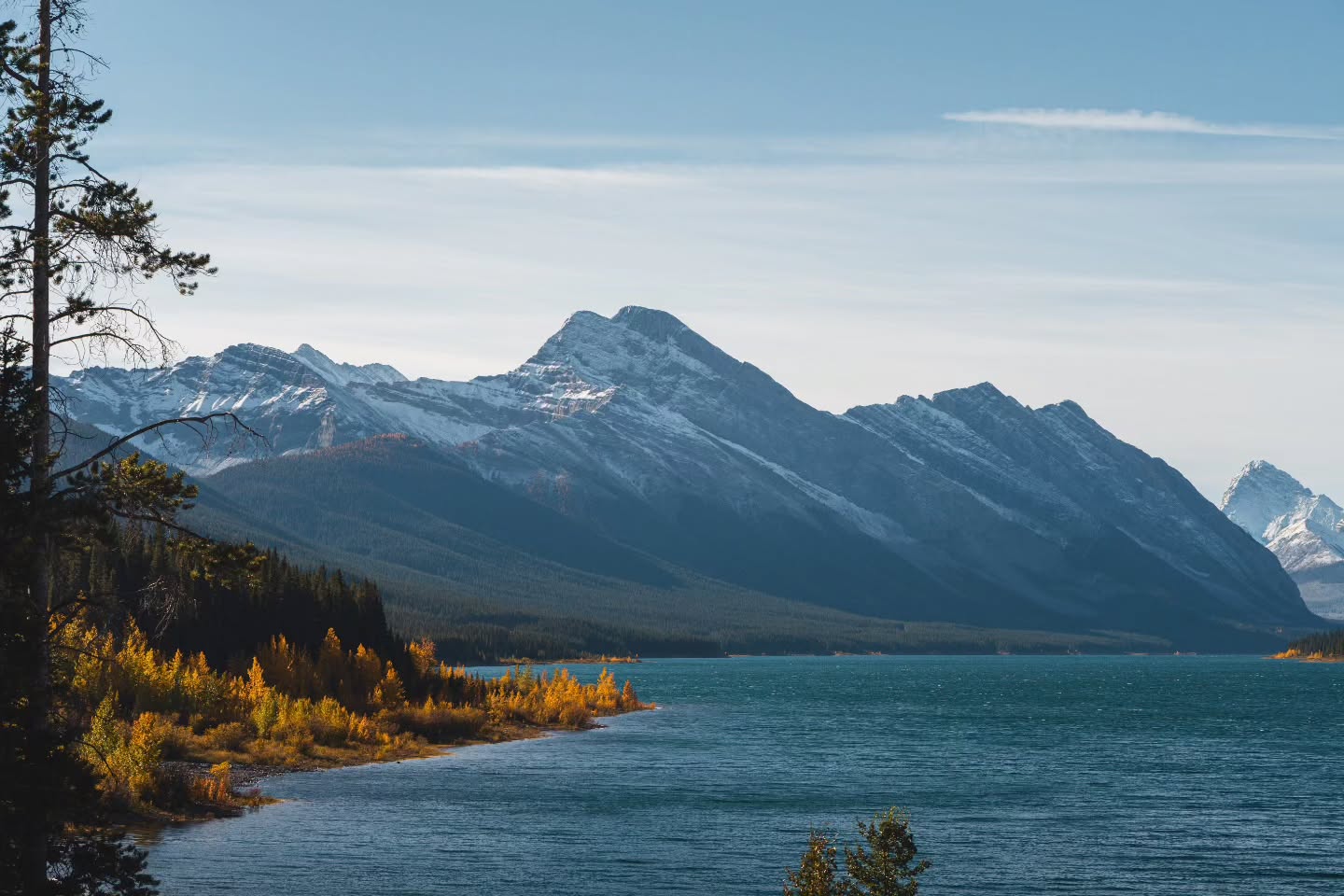
Banff Blue — snow-dusted Rockies over a turquoise lake at first light. See the print →
A large landscape print changes a room the way a window does. It gives a blank wall a horizon, and it gives the people in the room somewhere to look when the conversation pauses. But large prints also punish guessing: a print that is too small looks lost on the wall, and a print that is too big crowds the furniture underneath it. This guide is the short version of what Tyler tells buyers — measure first, pick the photograph second, and let the medium follow the room.
Start with the wall, not the photograph
Tape the outline on the wall before you buy anything. Painter's tape is cheap and honest: mark the size you are considering, live with the rectangle for a day, and look at it from the chair you actually sit in. Two rules of thumb do most of the work. First, over a sofa, the print should be about two-thirds the sofa's width — a 24×36 over a standard sofa reads as a picture; a 40×60 reads as a feature. Second, hang the centre of the print at about eye level, roughly 57 to 60 inches from the floor. The room preview on the buying guide shows every print on this site at the same scale as an 84-inch sofa, so you can check the size against furniture you already own instead of imagining it.
What counts as large?
On this site, large starts at 24×36. The landscape ladder runs 18×24, 24×36 and 30×45, plus panoramas at 12×36, 20×40 and 24×48; the wildlife prints go bigger still, up to 40×60, because a bear at first light wants a wall to itself. Panoramas suit long, low walls — above a sideboard, along a hallway, over a bed — where a standard rectangle would leave dead space at the edges. Verticals suit narrow walls and stairwells. If your wall is wider than it is tall, start with a panorama; if it is taller than it is wide, start with a vertical crop like Falls After Rain.
Paper, metal or canvas?
There are three mediums here, and the honest answer is that all three are good — they are different, not ranked. Fine-art paper is the classic gallery look and the most affordable way in; it needs a frame, and the mat and glass are part of the picture. Gallery metal is the boldest: the image is infused into aluminum, the color runs deep, there is no glare, and it arrives ready to hang with a float mount. Canvas is warm and textured, stretched over a wooden frame with the edges wrapped, also ready to hang. Each print page on this site recommends one medium for that photograph, in plain words — Alpine Lake at Dusk wants lustre paper for the detail in the peaks; Banff Blue wants metal for the turquoise water. Trust the recommendation, then trust your room: a bright room with a window opposite the wall will thank you for metal or matte paper, not gloss.
Framing: the part people skip
A frame is not decoration — it is the border between the photograph and your wall, and the wrong one fights the picture. Black wood is the safe default: it disappears and lets the photograph do the work. White wood suits pale walls and bright rooms. Natural wood warms a room with timber in it already. Every framed print here is solid wood, hand-finished, with a 4-ply archival mat and museum acrylic, and framed 18×24 starts from $189. If you already own a framer you love, buy the print only and take it to them — the paper prints are made for exactly that.
Pick the photograph, not just the size
Size is arithmetic; the photograph is the decision. A large print is a photograph you will live with for years, so buy the morning, not the mountain. Tyler's prints are real places in real light, and each one carries its story on its page: the alpine lake where the light held for ten minutes, the Banff viewpoint at first light before the light went flat, the fog moving through the pines in slow waves, the Minnesota sunset that is home ground. Stand in front of the photograph at full size on your screen, read the story, and notice which one you keep coming back to. That is the print. The size and the frame are just how it gets onto your wall.
Prints are having a moment — the numbers
You are not the only one putting a photograph on the wall. Grand View Research puts the global online art market at $11.09 billion in 2024, growing to $19.25 billion by 2033 — more than half of collectors now buy art online, and prints are the way most of them start. The wider art market tells the same story from the other end: Art Basel and UBS, in their Art Market Report 2025, counted $57.5 billion in global art sales in 2024 across 40.5 million transactions — up 3% on the year — and found that works under $50,000 make up 85% of dealer transactions by volume. The expensive end is thinning; the affordable end, where a print lives, is where the buyers are. At auction, Artnet's Price Database recorded 54,602 print lots sold in 2024 — the highest number in a decade — worth $368.4 million. And the wall itself is growing as a market: Polaris Market Research values the global wall art market at $59.42 billion in 2024, growing about 5% a year to $96.56 billion by 2034. A large print is not a trend purchase. It is the normal way people are filling walls now.
A short checklist before you buy
- Measure the wall, tape the outline, and live with it for a day.
- Check the width against the sofa or sideboard underneath — about two-thirds is the aim.
- Look at the photograph at full size and read its story before you look at the price.
- Pick the medium for the room: metal or matte where glare is a problem, canvas where warmth helps.
- Use the room preview on the buying guide — it shows the print at the same scale as an 84-inch sofa, not a guess.
Then buy the one you keep coming back to. Start with the Landscapes, or with Banff Blue and Minnesota Sunset — the two prints buyers ask about first — and if you are torn between two sizes, the bigger one is right more often than the smaller one. Walls forgive a large print. They do not forgive a timid one.
Sources
- Grand View Research, Online Art Market Size and Share report — global online art market $11.09 billion in 2024, projected $19.25 billion by 2033.
- Art Basel and UBS, Art Market Report 2025 — global art sales $57.5 billion in 2024; 40.5 million transactions, up 3%; works under $50,000 are 85% of dealer transactions by volume.
- Artnet Price Database, via Artnet News — 54,602 print lots sold at auction in 2024, the highest number in a decade; $368.4 million total.
- Polaris Market Research, Wall Art Market report — global wall art market $59.42 billion in 2024, projected $96.56 billion by 2034, about 5% a year.
Shop the landscapes → · Buying guide & room preview → · FAQ →